
Most people driving to Manali pass a small tunnel at Aut and never look left. That left turn is the road to Tirthan Valley, and it’s the best decision you’ll make in Himachal.
Tirthan Valley sits in the Banjar tehsil of the Kullu district, Himachal Pradesh, at roughly 1,600 meters. The Tirthan River runs through it, cold and loud, fed by glaciers inside the Great Himalayan National Park, a UNESCO World Heritage Site that starts right at the valley’s edge.
No malls. No paragliding touts. Just trout, deodar forests, and villages that still smell of woodsmoke.
I’ve been going since 2019, and it still hasn’t been swallowed by mass tourism. Partly geography (the valley dead-ends at the national park, so there’s no through traffic) and partly because the locals fought off a hydro project years ago and take conservation seriously.
Table of Contents
Quick facts
| 1 | 2 |
|---|---|
| Location | Kullu district, Himachal Pradesh, Banjar valley |
| River | The Tirthan, the only river in Himachal with no dam on it |
| Main base village | Gushaini, ~1,500 m |
| Known for | Gateway to the Great Himalayan National Park, trout fishing |
| Distance from Aut | ~30-35 km via Larji and Banjar |
| Distance from Delhi | ~490-506 km, 12-14 hours |
| Distance from Chandigarh | ~230-280 km, 7-8 hours |
| Nearest airport | Bhuntar, ~54-60 km |
| Nearest railway station | Chandigarh (~230-280 km) or Joginder Nagar (narrow gauge, closer but limited) |
| Best time | March to June, September to November |
| GHNP entry permits | Sai Ropa or Larji wildlife range offices |
Where is Tirthan Valley?
About 3 km after the Aut tunnel on the Chandigarh-Manali highway (NH3), a road branches off toward Banjar. Follow it past Larji, along the river, and you’re in. Gushaini and Nagini are the two main villages where most travelers stay. Banjar is the market town where you’ll find ATMs, a petrol pump, and the fisheries office.
Quick distances:
- Delhi to Tirthan Valley: around 500 km, 11-12 hours by road
- Chandigarh to Tirthan Valley: roughly 250 km, 7-8 hours
- Manali to Tirthan Valley: about 75 km via Aut, 2.5 hours
- Kasol to Tirthan Valley: around 90 km, 3.5 hours via Bhuntar
- Shimla to Tirthan Valley: about 150 km via Jalori Pass (seasonal) or 190 km via Mandi
- Aut to Tirthan Valley: 26 km, under an hour
- Jibhi to Tirthan Valley: just 8-10 km. You can do both in one trip, and honestly you should. I’ve written a full guide on Jibhi Valley if you’re pairing the two.
How to reach Tirthan Valley from Delhi
Three options.
By bus: Take any Delhi to Manali Volvo from ISBT Kashmere Gate (book on HRTC) and get off at Aut around 5-6 am. The fare runs ₹900-1,400 depending on the bus. From Aut, local buses leave for Banjar and Gushaini every hour or so (₹30-50), or a taxi costs ₹800-1,000. The overnight bus is the smart play; you wake up in the mountains with the whole day ahead.
By car: Delhi → Panipat → Chandigarh → Bilaspur → Mandi → Aut → Banjar → Gushaini. The highway is 4-lane till past Mandi. The Tirthan Valley road after Aut is narrow but paved and fine for hatchbacks; I’ve done it in an Alto. Drive the last stretch in daylight. There’s no petrol pump after Banjar, so top up there.
By air/train: Bhuntar Airport, roughly 54-60 km depending on exactly where in the valley you’re headed. The nearest broad-gauge railhead is Chandigarh; from there it’s bus or taxi.
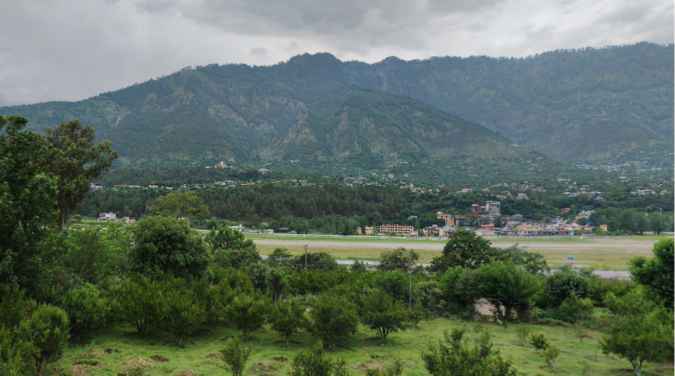
Tirthan Valley weather and temperature, month by month
This is the question I get asked most, so here’s the honest breakdown:
| Season | Months | Temperature | What it’s like |
|---|---|---|---|
| Spring | March-April | 10-22°C | Apple blossoms, clear skies, ideal |
| Summer | May-June | 15-27°C | Peak season, pleasant days, cold river dips |
| Monsoon | July-August | 15-22°C | Lush but risky, landslides near Aut |
| Autumn | October-November | 5-18°C | Golden light, empty trails, my pick |
| Winter | December-February | 0-10°C | Snow above Gushaini, some stays shut |
Best time to visit Tirthan Valley: March to June for comfort and trout fishing, October-November for solitude. Winter works if you want snow and don’t mind bukhari-heated rooms and occasional power cuts. I’d skip late July and August entirely; the Aut stretch gets dicey.
One thing about weather forecasts here: they’re unreliable. The valley makes its own microclimate. Pack a rain layer regardless of what the app says.
Things to do in Tirthan Valley
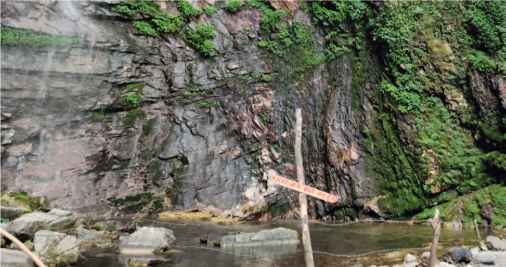
Trek to Chhoie Waterfall. A 45-minute forest walk from Gushaini, across the wooden bridge and up through the village. It’s the most searched-for spot in the valley and still somehow uncrowded. Go before 9 am and you’ll likely have the 40-metre fall to yourself. Wear shoes with grip; the last stretch gets slippery.
Enter the Great Himalayan National Park. Day permits cost ₹100 for Indians (₹400 for foreigners) from the Sai Ropa forest office. The Rolla trek, about 4 km inside the park along the river, is doable as a day hike and gives you a real taste of the wilderness. Multi-day treks to Shilt Hut or Rakhundi Top need a registered guide, roughly ₹1,500-2,000 per day, and they’re worth every rupee. I saw a Himalayan monal on the Rolla trail in April 2023 and I still talk about it too much.
Trout fishing. The Tirthan is one of the few designated angling rivers in India, stocked with brown and rainbow trout since British times. Permits cost around ₹100 per rod per day from the fisheries department in Banjar. Catch and release on most stretches. Several homestays lend rods and know the good pools.
Visit Chehni Kothi. A 1,500-year-old, 45-metre tower fortress near Banjar, built without mortar and still standing after multiple earthquakes. It’s a short steep hike from Shringa Rishi temple. Full details in my Chehni Kothi trek guide.
Drive up to Jalori Pass. At 3,120 metres, about 1.5 hours from Gushaini via Banjar and Shoja. From the pass, the walk to Serolsar Lake is 5 km of gentle oak forest. The pass closes in heavy snow (usually January-February). Here’s my complete Jalori Pass trek and travel guide.
Camping by the river. A few licensed operators run riverside campsites between Nagini and Sai Ropa, ₹1,200-1,800 per person with meals. Skip wild camping inside the park boundary; it’s prohibited and the fines are real.
Village walks. Bandal, Pekhri, and Nahin are hamlets above the valley floor with slate-roofed houses and zero tourists. Ask your homestay host for directions, or better, company.
Do nothing. Genuinely. Sit by the river with a book and a thermos of chai. That’s the product here.
Got extra days? Shoja village sits on the Jalori road 40 minutes away, and Shangarh in the neighbouring Sainj Valley, with its giant sacred meadow, is under 2 hours. Both are just as unspoiled.
The rest of the valley, and how it all connects
Once you’re here, the pieces you may already know start making more sense as one region instead of separate names on a map:
- Jibhi sits in the same broader Banjar valley system, a short drive from Gushaini, with more homestay options and a livelier village feel.
- Shoja and Jalori Pass are the higher-altitude side of the same region, reached via the same Banjar gateway town.
- Chehni Kothi, the 350-year-old wooden tower, is a short trek from the Banjar-Jibhi road, easy to fold into a Tirthan Valley trip without a separate detour.
Where to stay in Tirthan Valley
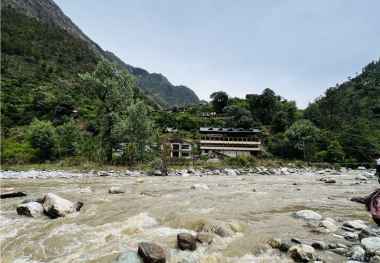
Skip the word “hotel” here. Tirthan runs on homestays, riverside cottages, and a handful of boutique resorts, mostly strung between Sai Ropa, Nagini, and Gushaini.
Budget (₹800-1,500 per night): Village homestays and a couple of hostels. You’ll eat what the family eats, usually siddu, rajma-chawal, and local red rice, and it’ll be the best food of your trip. Luxmi Homestay in Gushaini is a long-running favourite.
Mid-range (₹2,000-4,000): Riverside cottages around Nagini and Gushaini. Raju’s Cottage in Gushaini is the valley’s original guesthouse, running since the 90s, and books out weeks ahead. You literally cross a river on a pulley basket to reach it. Sunshine Himalayan Cottage near Sai Ropa is another solid pick with big park-facing views.
Upper end (₹5,000+): Boutique properties like Kudrat in Nagini and The Forest Edge above the valley, with proper linen, heaters, and food that goes beyond dal-chawal.
Book ahead for weekends between April and June, and for Christmas-New Year. The valley has maybe 130-odd properties total and the good ones fill fast. Most are on the usual booking platforms, but calling directly often gets you a better rate.
Cafes and food
Don’t expect a cafe scene like Kasol or Dharamkot. There are a handful of small cafes in Gushaini and along the Nagini stretch doing trout thali, pizza, and decent coffee. The trout thali (₹350-500) is the thing to order; the fish was probably in the river that morning. Otherwise, eat at your homestay. That’s where the real food is.
What a trip actually costs
For a 3-day trip from Delhi for two people, sharing:
- Volvo tickets both ways: ₹4,000-5,000
- Homestay, 3 nights mid-range: ₹7,500
- Food, permits, local taxis: ₹4,000-5,000
- Total: roughly ₹16,000-18,000 for two, or under ₹9,000 per head
Tour packages sell 3-day Tirthan-Jibhi circuits for ₹8,000-12,000 per person. Fine if you want zero planning, but this valley is easy to do independently and cheaper for it.
A rough 3-day plan
Day 1: Overnight bus, reach Gushaini by 8 am. Check in, sleep an hour, then walk to Chhoie Waterfall before lunch. Evening by the river.
Day 2: GHNP day permit and the Rolla trek, or a full day of trout fishing if that’s your thing. Trout thali for dinner.
Day 3: Day trip to Jalori Pass and Serolsar Lake via Shoja, or Chehni Kothi via Banjar. Catch the evening bus from Aut back to Delhi.
Have 5 days? Add a night in Jibhi and a village walk to Pekhri.
FAQ
Where is Tirthan Valley located?
In Banjar tehsil, Kullu district, Himachal Pradesh, about 26 km from Aut on the Delhi-Manali highway.
Is Tirthan Valley better than Manali?
Different animals. Manali has infrastructure and nightlife; Tirthan has silence and a national park. If you’re reading this far, you’ll probably prefer Tirthan.
Do I need a permit for Tirthan Valley?
Not for the valley itself. Only for entering the Great Himalayan National Park (₹100/day for Indians) and for fishing (about ₹100 per rod per day).
Is Tirthan Valley safe for solo travellers?
Yes, among the safest places I’ve travelled in Himachal. Homestay culture means you’re basically living with a family.
Does Tirthan Valley get snow?
Yes, usually December to February, heavier in the upper villages and at Jalori Pass. The valley floor at Gushaini gets a few snowfalls a year.
Is there mobile network in Tirthan Valley?
Jio and Airtel work in Banjar and patchily in Gushaini. Inside the park, nothing. Most stays have Wi-Fi of varying honesty.
Is it worth it?
If your idea of a holiday is Mall Road and momos, no. Go to Manali.
But if you want a valley where the loudest sound at night is the river, where a ₹1,200 homestay comes with home-grown apples, and where a UNESCO park sits at your doorstep, Tirthan is probably the best-kept non-secret in Himachal. I keep going back. Make of that what you will.